
SCHOOL GROUPS
The Center for Community Education at the Hawaiʻi Institute of Marine Biology
offers a unique opportunity for haumāna to explore Moku o Loʻe
through walking tours and/or hands-on labs.
Professional Development Workshops offered as well for teachers, staff, admin, etc.
2026 Reservations Open for Hawaiʻi Schools Grades K-8th
FIELD TRIP 101
Before you book, please review our program description including safety, labs, transportation, and expectations.

Safety
1. Due to safety considerations,
students must be 5 years of age or
older to participate in the program.
2. All participants 12 years of age and younger must wear a life vest the entire duration of the transit to Moku o Lo'e.
3. All participants must submit a HIMB Waiver Form before visiting.


Transportation
Large Groups (13-35 ppl)
Our research education vessel,
Ka Noelo Kai, will have a capacity of 35 max per trip. Pick up is at 9am from Heʻeia Kea Small Boat Harbor.
Small Groups (1-12 ppl)
For small groups, considered 12 or less, will be transported from Lilipuna Pier, with no boat fee.

Payment
Acceptable payment types:
cash, check, credit card, POs, IDOs
1. Cash/Check payments will be collected on the day of the event.
2. Credit card payments will be collected the day before the event via an email reminder link.
3. POs and IDOs are only accepted with advance notice.
 |  |  |  |  |  |
|---|---|---|---|---|---|
 |
How to Book
Confirm Transportation
1. Ensure transportation has been secured when booking and prior to confirmation email being sent.
2. Bus, charter, carpool, city bus, walking are all acceptable way to get to the pier for pick up.
3. Effectively communicate with school admin, transportation contact, and us.
2
Receive Confirmation Email
1. Thoroughly read + respond to confirmation email and invoice.
2. Ensure all adult and child waivers have been completed via online link before the trip.
3. Inform us how payment will be completed via cash, check, cc, PO, IDO, etc.
4. Ensure communication on any last minute changes, cancelations, or delays on day of trip.
3
 |  |  |  |  |  |
|---|---|---|---|---|---|
 |  |  |  |  |  |
 |  |  |
select a lab
Geared towards grades 4th-8th, this program offers 2 hands-on learning lab experiences for haumāna. Students become marine biologists on this 3-hour program consisting of common research techniques used in Kāneʻohe Bay, followed by a walking tour showcasing some highlighted research stations.
There are 2 available labs are an Invasive Algae & Invertebrate Lab or a Microscopic Plankton Lab.
Microscopic Plankton
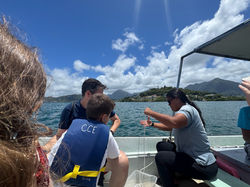
As our visiting marine biologists, each class will collect their own plankton sample by deploying a plankton net from our education vessel, Ka Noelo Kai, and tow through Kāneʻohe Bay during our trip to Moku o Loʻe.
Upon arrival, the students make their way to our Marine Science Research Learning Center where they observe the species under a microscope. Students will explore the Kāneʻohe Bay Plankton Field Guides to identify the different species of zooplankton found in the sample. Students learn to sketch scientifically by drawing commonly found zooplankton such as copepods, crab zoea (larvae), and chaetognaths (arrow worms), while focusing on the organisms most distinguishing features.


Invasive Algae & Invertebrate
Students sift through an invasive algae known as gorilla ogo or Gracilaria salicornia gathered from a lagoon at Moku o Loʻe. They pick out the small invertebrates and separate them by phylum in order to numerically characterize the habitat. By counting how many of each organism were found, they draw conclusions about the types of marine life an invasive algae-dominated habitat can sustain.
High Level Labs
(5th - 8th Grade Only)
As of Spring 2026, the Center of Community Education has now launched 3 brand new hands on lab modules for our Upper Level haumāna. Geared towards grades 5-8 for a hands-on learning experience.
Sea Level Rise
Students will be introduced to some natural occurrences that affect ocean water levels such as waves, storms, and currents. Then we will define sea level rise and the two main drivers that cause this increase in sea level: 1) Melting ice caps and glaciers and 2) thermal expansion. Students will conduct two hands-on experiments to visualize these drivers and really get a better understanding of how these global drivers are affecting their communities on a local scale. The lab will conclude by using a predictive modeling tool called the sea level rise viewer to visualize different areas around Oʻahu such as Oʻahu, Moku o Loʻe, and Waikīkī under 1ft, 3ft, and 6ft sea level rise changes.

Ocean Alkalinity Enhancement
Students will learn about solutions to combat Ocean Acidification. The lab portion focuses on Ocean Alkalinity Enhancement (OAE) where students explore how many natural minerals can be used in enhancing the alkalinity of our oceans in an effort to combat our rising sea chemistry. Students learn about the pH scale and its influence in their daily lives and in the ocean.

marine plastics
Students will be introduced to plastics, learn how plastics are found all throughout our environment, and the effects of plastics in our environment. Then we will define marine plastics and discuss the different types of marine plastics and the effects they have on Hawaiʻi. The lesson will start with a phenomenon to capture and focus attention on the topic. Real life and practical examples of items will be available for students to make an immediate connection to potentially complex ideas. Hands-on activities will be spread throughout the lesson to 1) visualize how plastics move through an ahupuaʻa, 2) understand how plastics can affect marine life, and 3) learn how to identify unknown plastics via buoyancy. The lesson will conclude by discussing recycling in Hawaiʻi and other ways we can reduce plastic consumption and marine debris.

program cost
HIMB Walking Tour
$110 for up to 20 participants, $10/additional participant
$130 for up to 20 participants, $10/additional participant
Flat Rate: $200
Huakaʻi to Moku o Loʻe (Labs)
Vessel Transportation
Hawaiʻi

HIMB Walking Tour
$210 for up to 20 participants, $20/additional participant
$355 for up to 20 participants, $20/additional participant
Flat Rate: $350
Vessel Transportation
Huakaʻi to Moku o Loʻe (Labs)
Out-of-State

Hawaiʻi High School Inquiry
Our program specifically focuses on family and community based opportunities, including tours and lab expeditions, designed for the general public as well as elementary and intermediate grade levels.
If you are interested in a more structured, curricular based lab experience for your Hawaiʻi DOE, charter, or private high school, we would recommend that you reach out to our sister program KeaoaLoʻe Lab - Science Inquiry Education Programs. You can fill out their inquiry form (which also includes a list of available modules) to start your reservation with them.